Advice for my future self as a person and as an OT

Gypsy love
What does the future hold ?

Hi everyone ! We are nearing the end of 2020. What a wild ride this has been. I hope that everyone is giving it their all till the end. Sadly this will be my last blog post for the year but as a great man once said …
… fresh and rejuvenated to tackle my 4th year of OT.

I think todays topic is very fitting as my last blog post for the year. Today we will be doing some introspection, attempting to do a self analysis and then giving our future self a cheat-sheet or survival guide for navigating life. Who knows you best other than yourself, right.  Below is a link for a template of writing a letter to my future self with some prompts to assist you in the writing process. It is also a free printable so you can keep a hard copy for your future self ! In the link section there is also a website that provides an interactive platform for people to share the letters they have written their future selves.

While thinking about the advice I would give to my future self being an OT I couldn’t help but analyze this activity. I found it very therapeutic and it felt like a self-care type of task. I first started by looking at my present self and writing down my strengths and weakness. This process definitely helped me improve insight into my abilities and was a confidence booster. I then focused on my weaknesses, then created tips on how to improve on these for the future.  

So here is my letter.

Dear future Nivashni

Here’s a cheat-sheet of tailored made advice for you.

1. Do not forget to be mindful. Practice some form of mindfulness as a form of self care. Pause, be in the present moment and notice all that is around you. Most importantly do not forget to appreciate and be grateful for all the small things in life. It will definitely help on those bad days to uplift your mood. With mindfulness comes self care, listen to your body and mind and replenish what is lacking. if you don’t take care of yourself you can’t give your best to your clients.

2. Do not stop learning. Remember when your Grade 12 English teacher would say READ,READ, READ…well she was right. Don’t stop reading, learning and absorbing knowledge from wherever you can be it your peers, reading journal articles or going for courses. By doing this you will be providing the best treatment to clients.

3. Manage your time better. Do not leave things for the last minute!!! Listen carefully Nivashni you do not work better under pressure, stop lying to yourself. Be more organized. Start making lists. Once you do this, you be amazed at the amount of time you have been wasting by procrastinating.

4. You are not perfect but embrace that. Do not strive for perfection in life, it will kill you. The thought of not doing something perfectly prevents you from actually starting the task.  Rather do the best you can and put all your energy into whatever you are doing. You’re best is the best.

5. Do not panic! Try to stop being the nervous nelly and instead go with the flow. Don’t get so flustered every time things don’t go as planned.  Embrace the change, the obstacles and mistakes that you make.

To all the reader you are inspired by this post to create a letter to your future self. We all do not know what the future holds and that’s what makes life exciting. Your past has shaped you into what you are now but that doesn’t mean you cannot change and grow. To prepare for the unpredictable future it’s a good idea to draw up a cheat sheet of all the things you have learnt. Share the knowledge you have with your future self.

I will end with an extract of a beautiful piece of poetry titled “New beginnings” by Lang Leav, “If I have learned anything this year, it is that I won’t ever be ready for what life throws at me. I won’t have the right words when it counts; I won’t know what to choose when fate itself is staring me down, But now I know I don’t always need to have the right answers.”

Links:

https://www.seleni.org/advice-support/2018/3/21/6-simple-steps-to-being-more-mindful

https://www.quora.com/If-you-could-give-one-life-advice-to-your-future-self-what-would-it-be

In a nutshell – coming out of your shell and beyond

Hi everyone! I hope everyone is keeping their spirits up during these tough times! Today’s topic is coming out of your shell and beyond. The first thing that comes to mind when I hear the phrase coming out of your shell is the famous idiom. According to (“come out of your shell”, 2020) coming out of your shell it means to become more confident in showing your true character and feelings. Everyone breaks out of their shell at different points in their life. For some it easy and for others it is a difficult process. I would rather use the term breaking or exploding out of one’s shell because it’s a liberal defining moment.  As you are reading this post I hope you are thinking about your journey of coming out of your shell because this is topic that relates to everyone.

I can definitely identify personally with this topic. My journey of exploding out of my shell with guns blazing took many years and many pep talks in front of a mirror. The process of chiseling away at your shell might need to happen more than, in different setting. For example, when coming to university I grew a new shell while in the unfamiliar environment. Once I become more comfortable in the new environment, I was able to break free again! I am very much an introvert and get very intimidate in large groups. With time my confidence grew, I felt more comfortable in my own skin and with the people around me, I knew it was time to show them who I really am. After coming out I found it easier to connect to people, it was also reassuring knowing the people around me accept my true nature. The journey of breaking out of your shell comes with growth and new experiences.

To all those still in their shells it’s alright, you and only you get to decide when you are comfortable enough to share with the world who you really are. For those who standing proud on the remains of tiny shell fragments, be supportive and share your experiences with others. You just might inspire someone. Check out the link below for tips on how you can get through this process.

I will leave everyone to ponder over the wise words of Tennyson, “ The shell must break before the bird can fly…”

Links:

References:

1. come out of your shell. (2020). Retrieved 12 November 2020, from http://www.idioms4you.com/complete-idioms/come-out-of-your-shell.html

COVID 19 – Trick or treat ?

Hi everyone! I hope everyone is keeping safe and optimistic in these ever changing times. It feels like years since my last blog post. Let me fill you in with all that has happened between my last blog post to now. We have finally moved into the second semester of the year this means a change of mindset from physical into psychosocial. Fieldwork has started but is a bit different to the usual set up. I have just completed my first block, one out of four, where we precited running groups like never before. Now enough about me today I will be talking about how COVID 19 has affected me as well as discussing the pros and cons which has come along with the pandemic.

What is COVID 19 ?

According to WHO, the COVID-19 is an infectious disease caused by a newly discovered coronavirus. It has affected 215 countries around the world (Worldometer, 2020). Read up on more information about COVID 19 on the links below.

How has COVID 19 affected me?

The pandemic has created a new normal and impacted people’s lives on multiple levels. Whether you are a student, worker, cat or dog, the virus does not discriminate. As a third year university student I have experienced both positive and negative effects.

As I mentioned earlier COVID 19 has changed the academic year for us. We now have four blocks providing a wider variety of different learning mediums. The different mediums include telehealth, simulated case studies, contact learning with peers and contact learning with patients. Allowing for different types of exposure and learning experiences to help equip students.

The inclusion of a block purely focused on running groups has changed my views on groupwork. Previously I found running groups very intimidating because you are treating more than one patient. I felt nervous as I did not feel capable of handling more than one patient at a time. The unpredictable reactions of the group members also made me feel unprepared. However, during this block I have gained confidence in running different types of groups. I had the opportunity to be a therapist, co-therapist and a patient. These three roles have provided me with a different perspective on groupwork. For example I was able to consider what I need to change as a therapist from a patients view. I hope to put into practice the valuable insight I have gained. We were also given the opportunity to run different types of groups therefore I was able to put into practice a variety of handling skills. The best part of being part of these groups was the simulated aspect. Students who acted as patients also benefited from recapping the presentation of various conditions we might come across. It also gave the therapists and co-therapists a chance to apply principles of handling, presentation and grading in response to the presentation of patients. I have also learnt the importance of the co-therapists role; the humble side kick who has your back. I was able to observe and implement concepts learnt in groupwork theory. A lot of peer learning has taken place during this block. I saw how my peers handled difficult situations in groups and gaining a new perspective. Working in COVID 19 conditions was initially stressful. The anxiety around contracting the virus and spreading it to vulnerable patients and peers was initially unbearable. However now working under these conditions provided me with the opportunity to get used to the new normal. It has reduced my anxiety, I now feel in control and I am able to fully concentrate on learning. It was also stressful as close contact activities cannot be done in the groupwork setting. I had to critically think about the types of activities done that will be suitable during these times.

The year 2020 has truly been a roller coaster, full of ups and downs. COVID 19 has brought with it good and bad factors. As I was typing this I have come to the realization that it is up to the individual to take a bad situation and turn it into something good. I have been challenged both physically and mentally. With these challenges came new learning experiences. For me COVID 19 has become unexpected treat.

Keep safe everyone! Remember to stop the spread by wearing your mask, washing your hands and practicing social distancing.

References:

1. Coronavirus Update (Live): 41,598,443 Cases and 1,137,968 Deaths from COVID-19 Virus Pandemic – Worldometer. (2020). Retrieved 22 October 2020, from https://www.worldometers.info/coronavirus/?utm_campaign=homeAdUOA?Si

2. Coronavirus. (2020). Retrieved 22 October 2020, from https://www.who.int/health-topics/coronavirus#tab=tab_3

Links:

For more information on COVID 19 and for resources check out the links below.

https://www.who.int/

https://sacoronavirus.co.za/

WhatsApp Support Line: 0600-123456

https://www.gov.za/Coronavirus

Teamwork !

Today’s topic is on collaborative practice and the multidisciplinary team.

What is a multidisciplinary team ?

The multidisciplinary team consists of a variety of health care workers who work together to provide comprehensive treatment. Nurses, doctors, social workers, physiotherapists, speech therapists, occupational therapists, psychologists are some of the health care workers who form part of the team. According to (Jefferies & Chan, 2004) the multidisciplinary team also know as the MDT aims to provide holistic treatment to patients during the course of their illness and at the different the three levels of care. (primary, secondary and tertiary) The coordinated effort of the team enables each disciplines therapy to complement and supplement each other. Good communication is a vital part when working with the MDT.

I was able to gather additional information about the patient from the other members of the MDT such as the nurses, previous OT and physiotherapist. My patient was referred to physiotherapy and a psychologist. The holistic approach was beneficial to the patient. At this chronic facility the MDT is able provide comprehensive treatment over a long period of time. An example of the MDT working together can be seen as the nurses allow the patient to perform as much as she can in self care tasks to continue to promote independence which the OT was working on.

Reflection on treatment session:

I did a leisure treatment session where the patient was positioned in the standing frame. She did nail care while in the standing frame. The activity was important to the patient as she previously studied to become a beautician. It helped to show the patient that there is a possibility for her to get a job in the same field in the future, and that she can skill meet the job demands even with the limitations of her condition. The aim was to maintain good postural control while in the standing frame. The standing frame would provide support therefore the patient did not need to focus on her balance to perform the fine motor task. However when the patient was put in the standing frame she had poor posture as she was hunched over the table to provide her with support. She also did not want to lift both hands up because she needed to support herself by having a hand on the table. This shows the importance of considering the psychological factors of anxiety and fear as it inhibited the patient from performing at her full potential.

Reflection on feedback:

The important feedback I received this week was that finding a balance between adapting the activity to make it easier to promote independence and keeping certain elements which are difficult to help improve performance skills. The activity can be structured to make it harder to work on certain performance skills when treatment is taking place but the method of completing the activity during daily use can be easier using principles of energy conservation. It is important to explain to the patient why the activity is being done in different ways. For example if the patient has poor dynamic balance the items needed for the activity can be placed for away to encourage movement out of the base of support to improve balance. however, when the patient is performing the same activity in their usual routine items would be placed as close as possible to decrease the amount of physical exertion.

Links:

1. https://www.health.nsw.gov.au/healthone/Pages/multidisciplinary-team-care.aspx#:~:text=A%20multidisciplinary%20team%20involves%20a,to%20deliver%20comprehensive%20patient%20care.

2. https://brandongaille.com/11-multidisciplinary-team-advantages-and-disadvantages/

3. https://prezi.com/tyojl_m99pfn/multidisciplinary-team-working/

4. https://www.cordisbright.co.uk/admin/resources/05-hsc-evidence-reviews-multidisciplinary-team-working.pdf

References:

1. Jefferies, H., & Chan, K. (2004). Multidisciplinary team working: is it both holistic and effective?. International Journal Of Gynecologic Cancer, 14(2), 210-211. doi: 10.1136/ijgc-00009577-200403000-00004

Getting back into action !

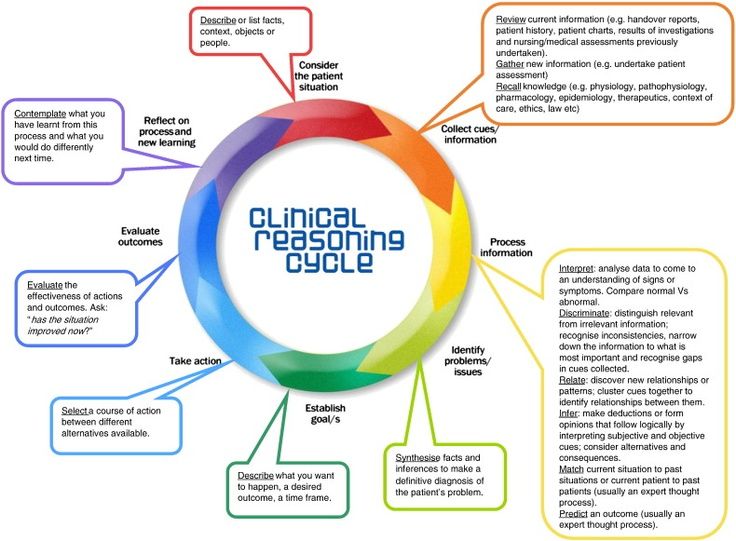
Hi everyone, it has been a while. We are finally back in action; assessing, treating and OTing ! I am now placed at a chronic facility which is completely different to the previous acute facility. The pace, atmosphere and time frame of conditions have changed therefore I have realized I also need to change the way I think and approach treatment. The topic for today is the clinical reasoning cycle, it has assisted me with this change of mindset.

 So what exactly is the clinical reasoning cycle ?  

It is the process by which health care workers collect cues, process the information, come to an understanding of a patient problem or situation, plan and implement interventions, evaluate outcomes, and reflect on and learn from the process (Hoffman, 2007; Kraischsk & Anthony, 2001; Laurie et al.,2001).

And what is it importance of clinical reasoning ?

According to () it is an important skill to develop and if it is implemented correctly it will have a positive impact on the patient’s outcomes. The clinical reasoning cycle is a process which helps health care workers provide the best possible therapy to patients.

How have I put clinical reasoning into practice you ask ?

I have considered my patient in their situation, as I know she is a 33 year old female who is a paraplegic and she had sustained a T11/12 fracture by falling. I was able to gather the information through conducting an interview and reading the patients file. The next step involved collecting information on the clients abilities in occupations, performance skills and performance context through preforming standardized assessments, functional based assessments and observations. (For example, I observed the patient is not able to sit on the edge of the bed without using her hands as support.) Once collecting the information from the assessments, it is processed and interpreted by comparing the assessment findings of the patient against the norms. (She therefore has impaired static sitting balance). Integrated problem statements are then created and used to establish goals. (The impaired balance affects her ability to participate in occupations independently such as transferring therefore an aim can be to improve balance.) Taking action involves preforming a treatment session with the patient. (I did a table top activity with the client on a bench, no back support to strengthen trunk muscles to improve balance.) Evaluation of the effectiveness of treatment and reflection will be done after the block.

The second topic for today is cultural humility. “In the medical context, cultural humility may be defined as a process of being aware of how people’s culture can impact their health behaviors and in turn using this awareness to cultivate sensitive approaches in treating patients” (Prasad et al., 2016). I practiced cultural humility during sessions because it helps when developing a rapport with patients. It also will help to understand the patient’s behavior when observing them performing tasks.

Reflection on treatment session:

After completing the relevant assessments I decided to the aim of intervention would be improving the clients impaired performance components such as balance, physical endurance, muscle strength of the upper limb and equilibrium reactions and postural control which would in turn increase the clients independence in occupations. One treatment session consisted of a wheelchair obstacle course which involved the patient moving through cones and up a ramp to improve physical endurance and muscle strength of the upper limbs. The patient was able to complete the session without difficulty, therefore upgrading should have been implemented. The structuring of the activity could have been adapted to increase the amount of resistance to improve the performance skills targeted. For example self propelling over grass. The number of repetitions for performing the course could have been increased to build endurance.

Reflection on feedback:

I learnt the importance of knowing when to use occupation as a mean vs occupation as an end. As well as how these two concepts will impact how one writes the principles of the session. I will apply the information gather from the feedback into the next week of prac ! Also an important point is  to validate your assessment finding statement with a standardized measure to ensure the correct interpretation of your assessment finding notes by other health care workers.  

References:

1. Hughes, R., Benner, P., & Sutphen, M. (2008). Patient safety and quality (Chapter 6Clinical Reasoning, Decisionmaking, and Action: Thinking Critically and Clinically). Rockville, MD: Agency for Healthcare Research and Quality.

2. (2020). Retrieved 15 July 2020, from https://www.utas.edu.au/__data/assets/pdf_file/0003/263487/Clinical-Reasoning-Instructor-Resources.pdf

3. Waters, A., & Asbill, L. (2013). Reflections on cultural humility. Retrieved 15 July 2020, from https://www.apa.org/pi/families/resources/newsletter/2013/08/cultural-humility

4. Prasad, S., Nair, P., Gadhvi, K., Barai, I., Danish, H., & Philip, A. (2016). Cultural humility: treating the patient, not the illness. Medical Education Online, 21(1), 30908. doi: 10.3402/meo.v21.30908

University of Natal, Pietermaritzburg

Links: https://hogg.utexas.edu/3-things-to-know-cultural-humilit

Am I a good communicator?

Communication skills are vital in any work setting however they are even more so in the health discipline where the patient’s health is influenced on how the multi-disciplinary team communicate with each other. Communication skills not only include verbal skills such as talking to other team members but also written skills in note writing. Communication does not just take place between one therapist to another but also between the therapist and patient.

I have not yet acquired the best communication skills. I definitely want to sharpen and improve this fundamental skill in order to provide the best treatment to patients. As a student I often feel intimidate when communicating with other members of the MDT, however I learnt and have seen how beneficial it can be to the patient if there is good communication between the MDT which promotes a flowing harmonisation where treatment from each medical practitioner complements the other.

This week I will share with you the treatment session done with one of my patients. A bit of background on the patient before we continue, her diagnosis is a left CVA (therefore she is a right hemiplegic). When planning what to do as treatment I looked at all the assessment findings and problem statements. After determining what performance skills the patient is lacking in, I looked for a functional activity that will get the patient to work on those problem areas. I decided on upper limb dressing as it will aid in empowering the patient with autonomy if she perform it independently. The session did not go as well as I hoped due to me not being familiar enough with the hemiplegic dressing methods. I now see how important it is for an activity to have a successful end, even if assistance is provided by the therapist.

I ran a paraplegic group this week. The focus of the session was to improve arm strength which is very important in self propelling in a wheelchair. We performed various stretches with weight bands put on the wrists to increase resistance, weight lifting, throwing the ball to each other as well as hitting it with a stick. I realised though the patients valued the talking aspect of the group, where they had the opportunity to ask questions and share their knowledge and experiences with each other.

I learnt the importance of activity analysis. The dreaded activity analysis has come back to haunt us from first year. By breaking the activity down and knowing what is required of the patient to perform the activity it will help with determining the correct treatment principles. I will definitely start to dissect activities. Research and practice of the treatment is important ! As a therapist it is important to be confident and not dawdle with the patient !

As Bret Morrison said : “Of all the life skills available to us, communication is perhaps the most empowering.” I am looking forward to how my journey through this year will help shape my communication skills !

Resources:

What does client centered mean to me ?

“ Client-centered occupational therapy is a kind of partnership between the client/patient and the therapist, which allows empowerment of the patient to engage in functional performance to fulfill his/her occupational roles in a variety of environments.(1) Philosophy of client-centered therapy includes empowerment and guiding of patients to achieve a cure by means of a balance of power between the therapist and patient. In this approach, the therapist acts as an educator”

“When a client-centered approach can be administered completely, the patient makes decisions alone based on his/her targets. In addition, the power is transferred from the therapist to the patient. In such a case, the therapist supports the decision-making period of the patient and accepts his/her decisions” -TONGA,, E., DÜGER, T. AND KARATAŞ, M.

What i really enjoy about OT is that we don’t just treat the patient, we get the patient involved in the process of healing. We work hand in hand with patients. Patients can set goals for themselves. We empower patients ! We are merely there to help guide them through this process.

Reflection on planning for intervention

Choosing a functional activity for treatment could be up there as one of the hardest decisions you will have to make !

I was able to decide fairly quickly this week what activities I wanted to do with my patients. I say fairly quickly because usually this process takes hours ! By getting collateral information from the nurses, OT and notes in the file I was able to get an idea of the patients level of function in ADL’s. Starting with basic ADL’s or self care tasks are vital as they will help to promote the feeling of autonomy for the patient if they are able to help or perform these tasks independently. I also went back to all the problem statements and assessment findings I had gathered so far to see how the activity will help to facilitate problem areas. I think I have almost gotten the hang of moving from using areas of occupations as just assessments (which was done last year) to now using them as therapeutic activities.

Reflection on implementing of intervention for your client

I decided on doing a very basic series of self care tasks with my patient as she required maximum assistance from the nurses. She preformed tooth brushing, face washing as well as grooming of the face which involved applying lotion and lip cream. The patient was able to help with part of the set up of the activity which involved taking out all the relevant items needed and clean up. I feel as though the session went relatively well. I was able to assess different types of prehensile hand function as well as bilateral hand function which the patient has an issue with. The structuring of the session could have been better as the space was limited in the room and the bathroom would have been a more appropriate setting. However the patient and I got through the activity without crying so that is a success for me !

Reflection on feedback from supervisor

This week I was able to get feedback on the SOAP notes and the implementation of treatment.

My supervisor was able to give me constructive feedback on how I can improve my SOAP notes which will make it easier for other health professionals to get an idea of how the patient is doing at a glance of the notes. I learnt that if SOAP notes are done effectively and efficiently, other health professionals will be able to compare them and deduce whether the patient is improving, has plateaued or is deteriorating. I now have a new found respect for SOAP notes and appreciation for them. They are not just another item of work lecturers want to pile on us !

The feedback I received for my treatment session was to give the patient time to react before assisting them in the task. The supervisor showed me the importance of this during the session. We were able to watch the patient see how she would deal with putting on the lid of a tube without any assistance. Initially I was positioning the tube in the patients hand in such a way she did not have to use a tip pinch (I assumed she did not have this function as she has decreased finger flexion) however when left on her own the patient performed the tip pinch and with minimal hand over hand facilitation she was able to perform the task. Therefore by giving the patient enough time to react one can observe even more of the patients abilities such as motor planning and problem solving.

How will this change the intervention you will provide next week

I will definitely use the feedback to improve the quality of the SOAP notes i do in the future as well as implementing this new handling method of giving the patient time to react. I am excited to see what more I can learn about my patient using the new skill my supervisor has taught me !

“Man, through the use of his hands, as they are energized by mind and will, can influence the state of his own health.”— Mary Reily, OTR, EdD

The trails and tribulations of the first week on prac !

“Tell me and I forget.

Teach me and I remember.

Involve me and I learn. ”— Chinese Proverb

The topic for this week is “From theory into practice” but before I start, I would like to give the readers an idea of the setting. I have been placed at a private physical rehabilitation facility for the semester. The well-oiled multidisciplinary team is made up of occupational therapists, gym assistants, physiotherapists, speech therapists, social workers, nurses and doctors. It was truly amazing to see how each team member plays such a vital role in the patient’s recovery. Patients admitted to the facility generally have a lengthy stay, the turn over rate is low. The atmosphere and staff at the facility as well as our supervisor are all friendly and willing to help which really calmed the nerves I was feeling on the first day.

Now back to the topic ! Up till now I have been attending lectures where slide upon slide is thrown your way providing the proper foundation to help guide students on how treatment should be done. However, it is one thing reading of slides and a completely different situation when you have a real living person in front of you expecting treatment. I felt very excited about treating patients for the first time as it finally the point where we can start helping patients.

During the first day I performed various assessments on the two patients that’s were assigned to me. The assessments included informal methods such as observations as well as the interview. The formal assessments conducted we chosen specifically to the patients condition, for example the patient experienced a CVA (stroke) one of the main aspects you would assess is tone. The supervisor performed an assessment session with a patient. This session was very informative and it helped give us an idea of where to start with assessing and what important observations need to be made.

While I was planning my treatment sessions for the patients I realized the importance of  being able to interpret assessment findings as well as gathering correct assessment findings. It is vital to get that right in order to provide the patient with the best possible treatment.  For my first treatment session I had planned to be bed mobility and reality orientation. The session went well and I was excited to use the NDT preparation techniques we have learnt at campus as a warm up. I learnt the importance of having the appropriate down grades for the activity.  

The feedback session with my supervisor was very informative. She was able to point out the areas where I needed to improve in both assessing and treating. During the session she provided me with helpful tips on how to improve handling skills and different techniques on how to assess reality orientation. She also helped me with prioritizing what should be assessed next.

I am very excited for the following sessions as they will provide me with the opportunity to improve my skills in both assessing and treating.  

Design a site like this with WordPress.com
Get started